How to Start a Profitable Faceless YouTube Channel in 2026, Using AI Video Generators

Faceless YouTube ChannelAI Video GeneratorYouTube GrowthYouTube Monetization

Starting a profitable faceless YouTube channel in 2026 is one of the few online business ideas that still feels very realistic to me. Not easy, no, but realistic… and that matters. You do not need to show your face, rent a studio, or buy expensive cameras just to begin. What you really need is a good niche, a repeatable content style, patience, and an efficient workflow that lets you publish without burning out after two weeks.

I say this from experience. I started a small faceless channel using AI-assisted tools for scripting, visuals, voiceover cleanup, and editing, and it grew past 2,000 subscribers. It did not happen overnight, and the first few videos were honestly kinda rough. But after I stopped chasing random ideas and built a proper system, things became much easier. The biggest lesson I learnt was simple, profit comes from consistency and clarity, not from making videos look flashy for no reason.

Quick truth: A faceless YouTube automation style channel is not magic money. But if you combine AI video generators, smart topic research, decent thumbnails, and a niche that advertisers actually care about, it can become a serious income stream over time.

Why Faceless YouTube Still Works in 2026

A lot of people think YouTube is too saturated now. I dont fully agree. What is saturated is lazy content. There are still many viewers searching for helpful videos every single day, especially videos that explain something clearly, solve a problem, compare options, tell a story, or save them time. Most viewers actually care far more about value than whether your face is on screen.

The reason faceless channels work so well is because they are scalable. You can create content using voiceovers, text animation, stock footage, AI-generated scenes, screen recordings, subtitles, charts, screenshots, or simple visual storytelling. That means you can focus on the actual thing that grows a channel, which is the idea and the packaging. When the topic is right and the title-thumbnail combination is good, even a simple video can perform suprisingly well.

Using AI video generators makes the process faster too. Instead of spending hours searching clips one by one, some tools can generate scenes from your script, add transitions, captions, music, and motion automatically. That saves time, which matters a lot when you are trying to upload regularly.

What makes a faceless channel profitable?
Usually a mix of ad revenue, affiliate links, digital products, sponsorships, and sometimes channel memberships later on. Even if ads start small, the channel itself becomes a digital asset.

Step 1, Pick a Niche That Makes Sense for Faceless Videos

This is where most people mess up. They hear “faceless YouTube” and instantly think they can upload on ten random topics and let AI do everything. That usually fails. A profitable channel needs a niche that has three things:

  • Viewer demand, people are actively searching or clicking it
  • Repeatability, you can make 50 to 100 videos without running out of ideas
  • Monetization potential, the audience can attract decent ad rates or related offers

Good faceless YouTube channel niches often include education, personal finance basics, tech explainers, productivity, history storytelling, AI tutorials, health habits, motivational storytelling, business case studies, software comparisons, mystery, facts, and documentary style content. You do not need to copy what is viral right now, you need to choose something you can stay consistent with.

I prefer niches where the viewer is already in “learning mode” or “solution mode.” Why? Because those viewers watch longer, search more videos, and are worth more in the long run. A random entertainment clip might spike fast, but an evergreen educational video can keep bringing views for months. That kind of content is what helped me slowly build traction.

A simple niche test I use:
Ask yourself, can I write 30 useful video titles in this niche today, without forcing it? If the answer is no, the niche may be too weak or too broad.

Step 2, Define the Exact Channel Style Before Uploading

One of the smartest things I did was deciding the channel style before I got serious. That means choosing how every video will feel. Is it documentary style? Fast-paced explainer? Calm educational? Top 5 format? Storytelling with captions? Screen-record tutorial? This matters because your workflow becomes faster when every video follows a known structure.

For a faceless AI channel, I like keeping the structure simple:

  1. Strong hook in the first 5 to 15 seconds
  2. Clear promise of what the viewer will learn
  3. Main points in logical order
  4. Pattern breaks with text, visuals, zooms, subtitles
  5. Short conclusion with a next-step feeling

When your videos all feel connected, viewers understand what your channel is about. YouTube understands it too. Thats important. A channel that uploads one AI tool video, then one football story, then one crypto rant, then one random meme video, usually confuses both viewers and the algorithm…

Step 3, Use AI Video Generators the Smart Way, Not the Lazy Way

AI video generators are tools, not a full business by themselves. This is where people get disappointed. They paste a script, click generate, upload exactly what comes out, and then wonder why no one watches. The tool can save time, yes, but the strategy still has to come from you.

What AI helps me with is speed. It can help draft a script outline, generate scene suggestions, build captions, create B-roll style visuals, polish voice audio, remove silence, and make editing much less painful. But I still review everything, change awkward lines, fix pacing, and make sure the finished video sounds like a real human made it.

That last part matters a lot. Viewers can forgive simple visuals, but they get bored fast if the video feels robotic. So use AI to assist, not to replace thinking.

Big mistake to avoid: Do not mass-produce low effort videos with generic AI voice, repeated stock clips, and zero originality. That kind of content often performs badly, and it can also create monetization problems later if your channel looks too templated or low value.

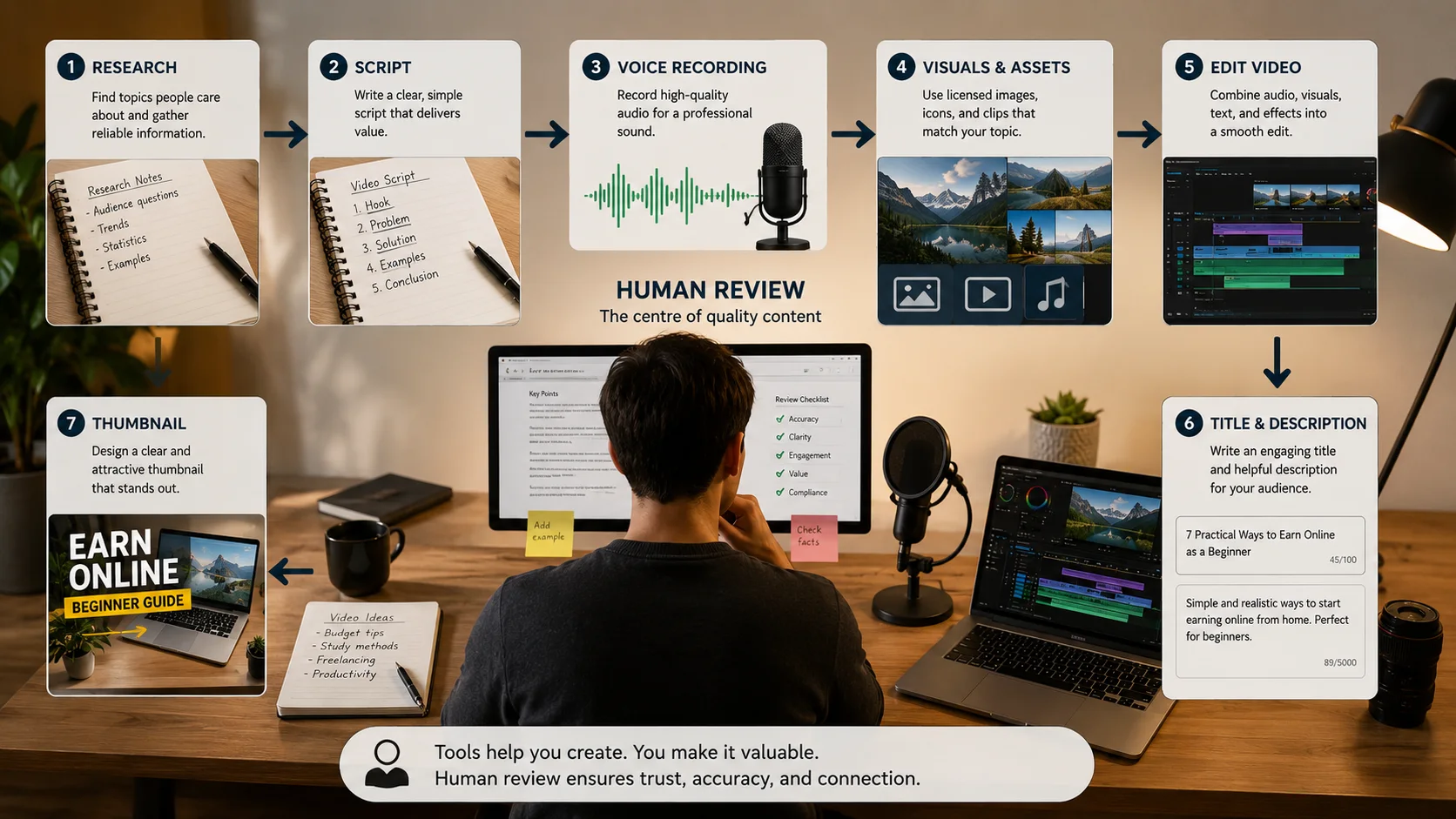
A practical faceless YouTube workflow using AI

  • Research a topic people already care about
  • Write a clean outline first, not the full script immediately
  • Turn the outline into a strong, viewer-focused script
  • Generate scenes, stock visuals, or supporting motion clips
  • Add voiceover, either your own, or a natural sounding AI voice with edits
  • Use subtitles, text highlights, and zooms to keep retention up
  • Finish with a clickable title and thumbnail that match the video promise

That process is much more reliable than trying to automate every single step from the start.

Step 4, Make Videos Around Search + Curiosity, Not Just “Cool Ideas”

When I was new, I made some videos that I personally liked, but nobody searched for them and nobody clicked them either. Thats when I realised YouTube is not just about creating, it is about packaging value in a way people instantly understand.

So now I think in two directions:

  • Search intent, videos people actively look for, like tutorials, explainers, comparisons, beginner guides
  • Curiosity intent, videos that create a strong “I need to know this” feeling

For a channel about AI, business, or educational content, this approach works really well. Search gives you evergreen views, curiosity gives you growth opportunities. A balanced mix is usually best.

Content Type Why It Works Good for Profit?
Beginner tutorials Searchable, evergreen, easy to rank over time Yes, strong for ads and affiliate links
Explainer videos Builds authority, good watch time when done well Yes, especially in finance, tech, business
Storytelling / case studies High retention potential, more shareable Yes, if thumbnails and hooks are strong
Random trend chasing Can spike, but usually inconsistent Sometimes, but risky long term

Step 5, Write Scripts for Watch Time, Not for “Fancy Writing”

A lot of beginners write scripts like school essays. That is a problem. YouTube scripts need momentum. Every sentence should either increase curiosity, explain something clearly, or move the viewer to the next point. If a line sounds pretty but adds no value, cut it.

I try to write like I am speaking directly to one person. Shorter sentences help. Cleaner transitions help. Small surprises help. A good faceless script has rhythm. It does not dump everything at once, it reveals information in a way that keeps people watching.

One thing that helped me a lot was writing the hook last. I would finish the main script first, then go back and create a sharper intro based on the most interesting part. That improved retention fast.

Simple hook formula: Start with a result, a mistake, a warning, or a surprising fact. Then quickly tell the viewer what they are about to learn. Keep it tight.

Step 6, Keep the Visuals Moving, Even if the Channel Is Simple

Faceless does not mean lifeless. This is huge. You do not need expensive animation, but you do need movement. Text on screen, scene changes, charts, close-ups, highlighted phrases, animated icons, progress bars, relevant B-roll, and subtitles all help maintain attention. The visual does not need to be complex, it just needs to support the point being spoken.

When I improved my editing style, even a little bit, average watch duration went up. Not because the videos became “cinematic”, but because they became easier to follow. The viewer never felt like the same still image was sitting there forever.

AI video generators can help a lot here, especially if you are creating educational or narration-driven content. But again, always review the output. Sometimes the visuals are too generic or they dont really match the sentence. That small mismatch hurts more than people think.

Step 7, Focus Hard on Title and Thumbnail

It sounds basic, but this is where the click happens. You can make a brilliant video and still fail because the title is vague and the thumbnail is cluttered. Your title should create a clear benefit, tension, or curiosity. Your thumbnail should support that idea fast, with very few words if any.

For faceless channels, thumbnails matter even more because the viewer is not clicking for your personality yet. They are clicking for the promise. So make the promise obvious.

I like asking two questions before uploading:

  • Would a stranger instantly understand what this video is about?
  • Would they feel any reason to click right now?

If the answer is weak, I rework the packaging. Honestly, some of my better performing videos were not the “best videos”, they were just packaged better.

Step 8, Monetize in Layers, Not Just With Ad Revenue

If your goal is to build a profitable faceless YouTube channel, do not think only about ads. Ads are great, but they are only one part of the business. A smart channel earns in layers.

Here are the main monetization paths that stay relevant for faceless content:

  • Ad revenue, once your channel becomes eligible
  • Affiliate links, especially for software, tools, courses, books, or services related to your niche
  • Digital products, templates, guides, checklists, mini-courses
  • Sponsorships, once your audience becomes attractive enough
  • Consulting or lead generation, only if it fits the niche naturally

The beauty of faceless YouTube is that the content can keep working in the background. A good evergreen video can bring views and clicks months later. That is why I like this model so much. Each video can become a tiny long-term asset if you make it useful enough.

Important: For ads and broader brand safety, keep the content original, helpful, and not misleading. Avoid spammy promises, misleading thumbnails, recycled content, and thin low-value videos.

Step 9, Upload Consistently, But Make a System You Can Actually Survive

Consistency matters, but fake hustle is useless. I have seen people announce they will upload daily, then vanish after 9 days. A better plan is to choose a schedule you can realistically keep for months. For some channels that is two videos a week. For others, one strong video each week is enough.

What helped me most was batching. I would research several ideas in one sitting, script a few together, then record or generate assets in groups. That saved so much time. Instead of starting from zero every day, I had a pipeline. Research day, script day, editing day, upload day… much easier mentally too.

If you are using AI tools, batching becomes even more powerful. You can create a content system instead of relying on motivation. And trust me, systems beat motivation every time.

Step 10, Study the Data Without Becoming Obsessed

Analytics matter, but they can also mess with your head if you refresh them all day. I check the basics, click-through rate, average view duration, retention drops, traffic sources, and which videos keep getting suggested. That tells me what the audience responds to.

If a video gets impressions but few clicks, the packaging might be weak. If it gets clicks but people leave early, the intro or pacing might be the issue. If an old video keeps bringing views, that is a clue that I should make more content around that angle.

Try to stay calm with early numbers though. Some videos start slow, then pick up later. I have had videos that looked dead for days, then slowly became some of the most useful ones on the channel. So yes, track the data, but dont panic too fast.

Common Mistakes That Kill Faceless Channels Early

  • Choosing a niche only because it looks easy, easy for you often means boring for viewers
  • Uploading generic AI-made videos with no editing, viewers feel it instantly
  • Changing niche too often, the channel never builds an identity
  • Ignoring thumbnails and titles, which means fewer clicks no matter how good the video is
  • Quitting before data becomes meaningful, many channels are abandoned too early
  • Copying big channels too directly, inspiration is fine, cloning is not
Another truth most people avoid: If every part of the video feels replaceable, the channel itself becomes replaceable. Add your own structure, your own taste, your own voice, even if your face never appears.

My Honest Advice if You Want Results

If I had to restart from zero today, I would do this… choose one evergreen niche, define one repeatable format, publish consistently, improve titles and thumbnails every week, and use AI only where it saves time without reducing quality. I would not try to automate everything on day one. I would focus on making each video slightly better than the last one.

That is really how a profitable AI faceless YouTube channel starts. Not with some secret hack, but with good decisions repeated long enough. My own channel did not grow because I found a magic tool. It grew because I stopped treating videos like random uploads and started treating the channel like an actual business.

Once I had a few videos bringing steady views, things changed. I could see which topics had potential, what viewers clicked, what retention looked like, and where monetization made sense. That is when the whole thing felt real. Hitting 2,000 subscribers was exciting of course, but the bigger win was realising I had built a content machine that could keep growing if I stayed consistant.


Final Thoughts

So yes, starting a faceless YouTube channel in 2026 using AI video generators is still worth it, if you do it properly. You do not need to be famous. You do not need to show your face. You do not need a perfect voice or expensive gear. What you do need is a niche with demand, a workflow you can repeat, original value, and the patience to improve over time.

If you are serious about building a faceless YouTube automation style business, start small but start clean. Pick one lane. Make the videos useful. Keep the visuals moving. Learn from the analytics. And above all, dont let AI make the channel lazy. Let it make the channel faster.

Your best next step: Choose your niche, write 20 video title ideas, and build your first 3-video content plan today. That one move alone will put you ahead of most people who keep “researching” but never upload…

Disclaimer: This article is for educational purposes only. Platform policies, monetization requirements, and tool features can change over time, so always review the latest official guidelines before making major channel decisions.

Scroll to Top