Why You Feel Broke Even After Earning Money Online

Earning money online sounds amazing from the outside. You work from your laptop, you get paid through platforms, you can build your own schedule, and sometimes you even make money while sitting at home. But here is the part many people do not talk about enough: you can earn online and still feel broke.

I have seen this happen with freelancers, bloggers, content creators, affiliate marketers, eBay sellers, small digital product sellers, and even people doing side hustles on platforms like Fiverr and Upwork. Money comes in, but somehow it disappears fast. You check your wallet or bank account and wonder, “Wait, I earned this month, so why do I still feel like I have nothing?”

This feeling is more common than people admit. The problem is not always that you are lazy or bad with money. Sometimes the problem is that online income behaves very differently from a normal monthly salary. It can be irregular, unpredictable, delayed, reduced by fees, affected by refunds, and sometimes spent before you even understand your real profit.

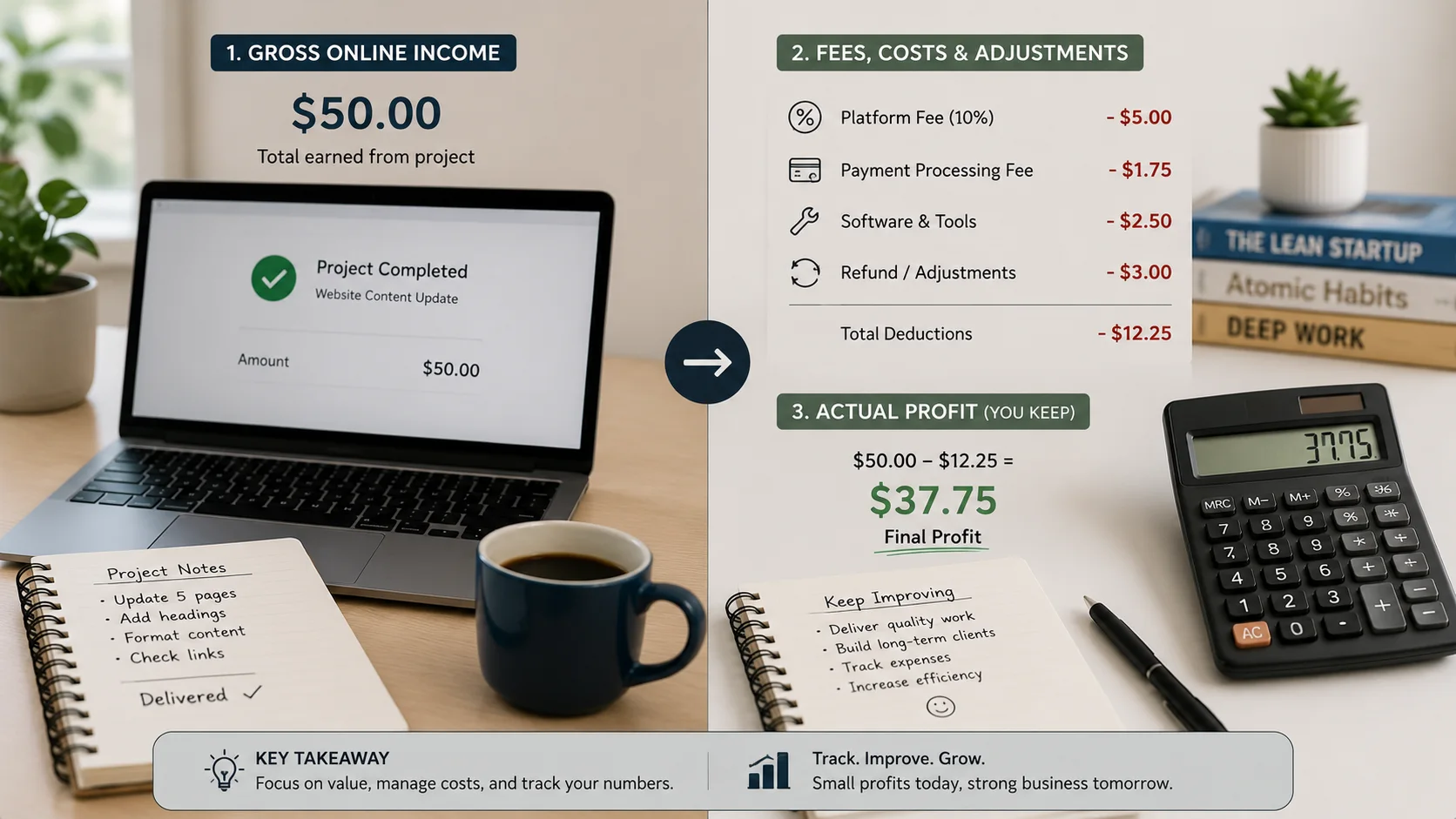
Quick thought: Online income is not just money received. Real online income is what remains after platform fees, payment fees, business expenses, taxes, refunds, and your own spending habits.

In this article, I want to break this down from my point of view. If you are earning through freelancing, selling services, doing dropshipping on eBay, creating content, running a blog, or trying small online side hustles, this can help you understand why you still feel broke and how to fix it slowly, without making your life complicated.

1. You Are Counting Gross Income, Not Real Profit

This is one of the biggest reasons online earners feel broke. We look at the full amount we earned and feel like we made good money. But that full amount is not always ours.

Let’s say I complete a freelance job on Fiverr for $100. At first, it feels like I made $100. But after platform fees, withdrawal charges, currency conversion, and maybe tools I used to complete the work, the real amount I can use may be much lower.

Same thing can happen with Upwork. A client pays for a project, but you still have service fees, payment processing delays, and maybe software costs. If I write articles, design logos, edit videos, or build websites, I might also spend money on Canva, hosting, plugins, stock assets, AI tools, internet, electricity, and other things.

With eBay dropshipping or online selling, the difference is even more serious. A product may sell for $30, but that does not mean I made $30. I need to subtract product cost, shipping, eBay fees, payment fees, possible refunds, returns, promoted listing costs, and sometimes exchange rate losses. After everything, the real profit might be $5, $8, or even less.

Simple rule I like: Never celebrate the full sale amount. Celebrate the profit after all costs are removed.

If I keep thinking, “I made $1,000 online this month,” but my real profit is only $500 after expenses, I will naturally feel broke because my brain is spending based on the $1,000 number while my real life is running on the $500 number.

2. Online Income Comes Randomly, But Bills Come on Time

A normal job usually pays on a fixed date. Online work does not always work like that. Some clients pay late. Some platforms hold payments. Some orders get delayed. Some months are busy, some months are painfully slow.

On Fiverr, you might get 5 orders this week and nothing next week. On Upwork, a client may pause the project. If you run a blog, ad income can go up and down depending on traffic, season, ad rates, and even where your visitors come from. If you sell on eBay, one week can be great and the next week can be quiet.

The difficult part is that bills do not care about your online income cycle. Rent, food, internet, electricity, subscriptions, loan payments, and family expenses come on time. So even if you earned well earlier, one slow week can create pressure if you did not save anything from the good week.

This is why many online earners feel financially unstable even when they are earning. The income is real, but the timing is not stable.

3. You Spend Like the Good Month Will Continue Forever

When I earn more than expected, it becomes very easy to relax. I may think, “Okay, I am finally making money online, I deserve something.” And honestly, rewarding yourself is not wrong. The problem starts when one good month becomes an excuse to upgrade everything.

Maybe you buy a new phone, new laptop, expensive software, better chair, courses, subscriptions, paid themes, plugins, ads, and other things. Some of these can be useful. But if you spend everything during a good month, you may struggle during a slow month.

This happens a lot with freelancers. A person earns $2,000 from a big project and feels rich. Then they spend most of it. Next month, the project ends and they only earn $600. Suddenly, panic starts…

The better way is to treat high income months carefully. I personally think online earners should not build their lifestyle based on their best month. They should build it based on their average or lowest safe month.

Be careful: One good month is not proof that your income is stable. It is a good sign, but not a guarantee.

4. You Do Not Have a Personal Salary System

One mistake I see often is taking money randomly from online income. If money comes in, we spend from it. If more money comes in, we spend more. This feels normal at the beginning, but it becomes messy fast.

A better system is to pay yourself a fixed personal salary from your online earnings. Even if you are not a registered business yet, you can still use this idea in a simple way.

For example, if my online income changes every month, I can decide that I will only use a fixed amount for personal spending. The rest stays for savings, tax, tools, business growth, and slow months.

Let’s say I earn $1,200 this month. Instead of spending based on $1,200, I might pay myself $600 and keep the remaining $600 for business and future safety. If next month I earn only $700, I still have some backup from the previous month.

This one habit can reduce stress a lot because it stops the “earn and spend everything” cycle.

5. Small Online Expenses Are Eating Your Money

Online earning usually comes with tools. At first, each tool feels cheap. $10 here, $15 there, $20 for this, $12 for that. But after a few months, these small payments can become a silent money leak.

Common online expenses include:

  • Canva, design tools, or stock image websites
  • AI writing, video, or image generation tools
  • Website hosting and domain renewals
  • WordPress themes and plugins
  • Email marketing tools
  • VPNs, proxies, or research tools
  • Paid ads for testing products
  • Freelance platform membership or connects
  • Payment transfer and currency conversion fees

Some tools are worth it. But not every tool is needed every month. Sometimes we subscribe to something during an excited moment and forget to cancel it. Then it keeps charging quietly.

I think every online earner should do a subscription check once a month. Ask yourself, “Did this tool help me make money this month?” If the answer is no, maybe pause it. You can always buy it again later when you really need it.

6. You Are Working Hard, But Not Tracking Anything

One painful truth is that working hard online does not always mean making profit. You can spend 10 hours on something and earn very little. You can also spend 2 hours on the right task and earn more.

This is why tracking is important. Not complicated accounting, just simple tracking.

If I am freelancing, I should know which service makes me the most money. Maybe logo design pays better than data entry. Maybe article writing takes too much time, but website fixes pay faster. Maybe Fiverr brings more orders, but Upwork clients pay better.

If I am doing eBay selling, I should know which product gives real profit after all fees. A product that sells fast is not always a good product if the margin is too low. Sometimes a slower product with better profit is safer.

If I run a blog, I should know which topics bring traffic and which articles earn more ad revenue. If finance articles perform better than random topics, then I should create more useful finance content. If a post gets traffic but no revenue, I should understand why.

Income Source What People Usually Count What Should Be Tracked
Fiverr or Upwork Total client payment Net income after fees, time spent, revision work, and software costs
eBay Dropshipping Product sale price Profit after product cost, shipping, eBay fees, returns, ads, and refunds
Blogging Ad revenue shown in dashboard Revenue minus hosting, domain, content cost, tools, and promotion
Affiliate Marketing Commission earned Commission after traffic cost, content cost, refunds, and payout limits

When you track properly, you stop guessing. You start seeing what is actually working.

7. You Confuse Cash Flow With Wealth

This is another big reason people feel broke. Cash flow means money is moving in and out. Wealth means you are keeping some of it and building something stable.

A person can receive $5,000 per month and still be broke if they spend $5,200. Another person can receive $800 per month and slowly build savings if they spend carefully and keep improving.

Online income can create an illusion of success because payments may look exciting. You get notifications, order completions, affiliate commissions, ad revenue updates, or client payments. It feels like progress. But if none of it stays with you, you are only moving money around.

The goal should not only be to earn online. The goal should be to keep a part of what you earn, use some to grow, and protect yourself from bad months.

8. Taxes Can Make You Feel Broke Later

Taxes are not the same in every country, so I will keep this general. But wherever you live, online income may still need to be reported depending on your local rules. This is something many beginners ignore.

The problem is that platforms usually pay you without removing enough tax, or sometimes without removing tax at all. So the money feels fully yours. Then later, when tax time comes, you may realize you should have saved a portion.

This can make someone feel broke very suddenly. They thought they were doing okay, then a tax bill or accounting issue appears.

A simple habit is to set aside a percentage from every payment. It does not need to be perfect at the start. Even saving 10% to 20% in a separate place is better than saving nothing. For exact advice, it is always better to talk to a local accountant or tax professional because rules can be different depending on your country and income level.

My simple mindset: If I receive online income, I should not treat 100% of it as spending money. A part of it may belong to taxes, tools, savings, or business costs.

9. You Are Underpricing Your Work

Many people start freelancing by charging very low prices. I understand why. At the beginning, you want reviews, experience, and confidence. On Fiverr, beginners may offer services for $5 or $10. On Upwork, they may accept low hourly rates just to win a client.

This is okay for learning, but if you stay there too long, it becomes a problem. Low pricing can make you busy but still broke.

For example, if I charge $10 for a task that takes 3 hours, I am not really making good money. After platform fees and time, it may not be worth it. If I do this again and again, I feel exhausted and still financially stuck.

The solution is not to suddenly charge crazy prices. The solution is to improve your skill, collect proof, make your profile stronger, and slowly increase your rate.

Instead of offering “I will do anything,” offer specific services. For example:

  • Instead of “I will write content,” offer “SEO blog posts for personal finance websites.”
  • Instead of “I will design anything,” offer “clean YouTube thumbnail design for finance and tech channels.”
  • Instead of “I will help with Shopify,” offer “product page optimization for eCommerce stores.”

Specific skills usually look more valuable. And when your work is more valuable, you can charge better.

10. You Have Too Many Side Hustles at the Same Time

There is nothing wrong with trying different online income methods. I also like exploring new ideas. But doing too many things at once can make you feel busy without real progress.

One day you try Fiverr. Next day you try Upwork. Then you start eBay dropshipping. Then affiliate marketing. Then YouTube Shorts. Then blogging. Then digital products. Then crypto faucets or small reward sites. After a while, you are tired, but no system is strong enough to pay you properly.

The better approach is to test, then focus.

You can choose one main income source and one backup source. For example, freelancing can be the main source, while blogging grows slowly in the background. Or eBay selling can be the main source, while affiliate content supports it. But trying to build 7 things at once can make your mind and money scattered.

Focus idea: Pick one main income method for the next 90 days. Track it, improve it, and only add another method when the first one becomes stable.

11. Payment Delays Can Trick Your Brain

Online platforms often have payment delays. Fiverr has a clearing period. Upwork payments can depend on hourly or fixed contracts. Ad networks may pay monthly, sometimes after reaching a minimum threshold. Affiliate networks may hold commissions until refund periods end. eBay payouts may also depend on account status, delivery, and payment rules.

So you may “earn” money today, but you may not receive it today. This gap can create confusion. Your dashboard says you made money, but your real wallet is still low.

This is why I do not like counting money as available until it is actually withdrawable or received. Dashboard numbers are motivating, but they are not always usable cash.

A simple fix is to separate your money into three categories:

  • Pending income: Earned but not yet received.
  • Available income: Received and ready to use.
  • Safe income: Money left after fees, expenses, taxes, and savings.

Once you think this way, your financial picture becomes more honest.

12. Refunds, Returns, and Chargebacks Are Part of Online Business

When earning online, not every payment is final. A client may request a refund. An eBay buyer may return a product. A customer may complain. A payment may be reversed. An affiliate commission may be cancelled if the buyer refunds the product.

This is normal in online business, but many beginners do not prepare for it.

If I spend all my money as soon as I receive it, a refund can hurt badly. But if I keep a small reserve, I can handle these situations without panic.

For online sellers, this is very important. If you are dropshipping or reselling on eBay, always keep some money aside for refunds, returns, and supplier issues. Do not use every dollar of sales money as personal income.

13. You Are Not Building an Emergency Fund

An emergency fund is boring until you need it. Then suddenly it becomes the most important thing.

Online income can stop for many reasons. A platform account can get limited. A client can disappear. A product can stop selling. Website traffic can drop after an update. Ad rates can go down. Your laptop can break. Your internet can have problems.

If you have no emergency fund, even a small issue feels huge. This is why earning online without savings can still feel stressful.

I think beginners should first aim for a small emergency fund. It can be $100, $300, $500, or whatever makes sense in your country. After that, build toward one month of basic expenses. Then slowly aim for three months.

The goal is not to become rich overnight. The goal is to stop one bad week from destroying your whole month.

14. You Compare Your Start With Someone Else’s Highlight

This one affects your mind more than your wallet, but it matters. Online, people love showing big numbers. “I made $10,000 this month.” “My store did $50,000 in sales.” “I got 1 million views.” But they do not always show expenses, losses, ads spent, refunds, taxes, years of effort, or failed projects.

If I compare my early stage with someone’s best screenshot, I will feel poor even if I am improving.

Maybe someone made $10,000 in eBay sales, but their profit was only $1,000. Maybe someone got $3,000 from freelancing, but they worked day and night. Maybe a blogger earns well now, but spent years writing with almost no income.

Comparison can push you to grow, but it can also make you feel behind for no reason. Your real comparison should be your own progress from last month.

15. How I Would Fix This Step by Step

If I wanted to stop feeling broke after earning money online, I would not try to fix everything in one day. I would build a simple system.

Step 1: Track all income and expenses

I would create a simple spreadsheet with date, source, gross income, fees, expenses, and final profit. This helps me see the truth clearly.

Step 2: Separate personal and online money

Even if I cannot open a business account yet, I would at least separate money mentally or use different wallets/accounts where possible. Mixing everything makes it hard to understand what is really happening.

Step 3: Pay myself a fixed amount

I would stop taking random money whenever I feel like it. Instead, I would decide a fixed amount for personal use and leave the rest for savings, tools, taxes, and slow months.

Step 4: Build a small buffer

Before upgrading my lifestyle, I would build a buffer. Even a small buffer can reduce stress a lot.

Step 5: Cut weak expenses

I would check every subscription and tool. If it does not help me earn, save time, or improve quality, I would pause it.

Step 6: Improve my highest earning skill

If freelancing brings the most money, I would improve that. If eBay selling works better, I would study products, pricing, returns, and margins. If blogging works, I would publish more useful content and improve SEO.

16. A Simple Monthly Money Routine for Online Earners

Here is a routine that can help a lot. It does not need fancy apps. A spreadsheet is enough.

  • Write down every income source for the month.
  • Subtract platform fees, payment fees, and currency conversion costs.
  • Subtract tools, subscriptions, ads, hosting, and product costs.
  • Calculate your real profit.
  • Move a portion to savings or emergency fund.
  • Keep a portion for taxes if needed in your country.
  • Pay yourself a fixed personal amount.
  • Review what made the most profit, then focus more on that.

This routine may look simple, but it can change everything. Most people feel broke because they do not have a clear picture. Once the numbers are clear, decisions become easier.

17. Online Income Is Still Worth It, But You Need a System

I do not want this article to sound negative. Earning money online is still one of the best opportunities available today. You can start with skills, time, creativity, and consistency. You can freelance on Fiverr or Upwork, sell on eBay, create a blog, build a YouTube channel, sell digital products, do affiliate marketing, or create your own small online business.

But online income needs discipline. It is not enough to make money. You need to manage it.

The people who survive online long term are usually not the ones who earn once and spend everything. They are the ones who build systems. They track numbers, improve skills, protect savings, manage risk, and stay patient.

Remember: Feeling broke does not always mean you are failing. Sometimes it simply means your money system is not strong enough yet.

Final Thoughts

If you feel broke even after earning money online, you are not alone. It happens to many beginners and even experienced online earners. The issue is usually not just income. It is cash flow, fees, spending habits, unstable payments, low pricing, no tracking, and no buffer.

The good news is that this can be fixed. Start by tracking your real profit. Stop counting gross income as spendable money. Separate business and personal money where possible. Save something from every payment, even if it is small. Build an emergency fund. Focus on the income source that actually works for you.

Online earning can give freedom, but only if you manage it properly. Otherwise, it can feel like money is always coming in and still somehow disappearing. I think the goal is not just to earn more, but to keep more, grow smarter, and create a life where one slow month does not break your confidence…

Small action for today: Open a simple spreadsheet and write down your last 10 online payments. Then subtract fees and expenses. That one step can show you the real picture.

Disclaimer: This article is for educational purposes only and should not be taken as financial, legal, or tax advice. Always check your local rules and speak with a qualified professional for personal guidance.

Scroll to Top