How to Separate Business and Personal Finances as a Side Hustler
When you start a side hustle, the first exciting part is earning your first payment. Maybe it comes from Fiverr, Upwork, eBay, YouTube, affiliate marketing, blogging, selling digital products, or even a small local service you do after school or work. That first payment feels good because it proves one thing, your side hustle is not just an idea anymore. It can actually make money.
But here is where many beginners mess up, including me when I first started looking at online income more seriously. The money comes in, then it goes straight into the same account used for food, transport, bills, phone data, subscriptions, and random spending. After a few weeks, you have no idea how much you actually earned, how much you spent, or whether your side hustle is even profitable…
That is why learning how to separate business and personal finances is one of the most important habits for a side hustler. It does not matter whether you are making $50 per month or $5,000 per month. The earlier you separate your money, the easier your life becomes later.
Why Separating Business and Personal Finances Matters
A side hustle can feel small in the beginning, so it is easy to think, “I do not need to organize this yet.” But that is the exact stage where you should build the habit. If you wait until the income gets bigger, the mess also gets bigger.
For example, imagine you are doing freelance logo design on Fiverr. You receive $100 from a client. Then you spend $20 on internet, $15 on a design tool, $10 on transport, and $30 on personal shopping. At the end, you may feel like you made money, but did you really know your profit? Not clearly.
Now imagine you are selling products on eBay, maybe reselling small items, testing dropshipping where it is allowed, or buying products locally and shipping them to buyers. You may receive $500 in sales, but that is not your profit. You still have product cost, shipping cost, platform fees, payment fees, refunds, packaging, and maybe ads. If all that money is mixed with your personal spending, you will feel rich for a moment and confused later.
Separating your finances helps you understand three things clearly:
- How much your side hustle earns before and after expenses.
- How much you can safely use personally without hurting the business.
- How much you need to keep aside for taxes, fees, tools, refunds, and growth.
This is not only about looking professional. It is about protecting yourself from bad decisions.
Business Money vs Personal Money, The Simple Difference
Before going into steps, let us make the difference simple.
Business money is money connected to your side hustle. It includes income, platform payments, business expenses, tools, ads, shipping, subscriptions, taxes, and reinvestment.
Personal money is money you use for your normal life. It includes food, rent, transport, personal shopping, family expenses, entertainment, phone bills, and savings for personal goals.
The problem starts when you use one account for both. You may think you will remember everything, but trust me, after 30 or 40 transactions, you will not. One Fiverr payment, one Canva subscription, one Upwork withdrawal, one eBay shipping cost, one grocery payment, one online order… suddenly everything is mixed.
Even a small side hustle deserves clean records. You do not need a huge company setup. You just need a basic system that helps you see what is going on.
Step 1: Open a Separate Account for Side Hustle Income
The first step is to create a separate place where your side hustle money enters. This can be a separate bank account, a digital wallet, a Payoneer account, Wise account, PayPal account, or even a separate local account depending on what is available in your country.
The goal is simple, do not let your business income land directly into your personal spending account.
For example:
- Fiverr income can go to Payoneer, PayPal, or your business bank account.
- Upwork withdrawals can go to a dedicated account instead of your everyday account.
- eBay sales money should stay separate until product cost, shipping, and fees are handled.
- Affiliate commissions should go into the same side hustle account, not straight into personal spending.
- Blog or YouTube income should be tracked separately before you use it.
You do not always need a registered business account in the beginning. In many cases, a separate personal account used only for business activity can still help you stay organized. But as your income grows, you should check your local laws and speak to a qualified accountant about whether you need a proper business account or registration.
Step 2: Track Every Side Hustle Payment
Once your income is separate, the next step is tracking. This sounds boring, but it is where real clarity starts. If you do not track your income, you may think you are earning more than you really are.
Let us say you completed a $100 project on Upwork. You may not receive the full $100 after platform fees. If you bought a tool or used paid software to complete the work, that also reduces your real profit. The number that matters is not just revenue, it is net profit.
You can track your income using Google Sheets, Excel, Notion, a budgeting app, accounting software, or even a simple notebook. Do not overcomplicate it in the beginning. A simple sheet is more than enough.
| Date | Platform | Income Type | Gross Amount | Fees | Net Amount |
|---|---|---|---|---|---|
| June 3 | Fiverr | Logo Design | $80 | $16 | $64 |
| June 8 | Upwork | Article Writing | $120 | $12 | $108 |
| June 14 | eBay | Product Sale | $45 | $6 | $39 |
| June 22 | Blog | Ad Revenue | $25 | $0 | $25 |
This kind of tracking helps you see which side hustle is actually worth your time. Sometimes a platform looks profitable from the outside, but after fees and time spent, the result is weak. Other times, a small income stream becomes powerful because it has low expenses.
Step 3: Track Business Expenses Separately
Income is only one side of the story. Expenses are the other side. A lot of side hustlers forget this and only count the money they receive.
If you are freelancing, your expenses might include:
- Internet or mobile data used for work
- Canva, Adobe, Grammarly, ChatGPT, or other tools
- Portfolio website hosting and domain name
- Online courses or learning materials
- Payment processing fees
If you sell on eBay, your expenses might include:
- Product cost
- Shipping supplies
- Shipping labels
- Platform fees
- Refunds and returns
- Product photos or editing tools
If you run a blog, YouTube channel, or affiliate site, your expenses might include hosting, domain renewal, content tools, keyword tools, editing software, thumbnails, or stock assets.
At first, these expenses may look small. But small expenses can quietly eat your profit. A $10 tool, $15 subscription, $12 domain, $30 ad test, $8 platform fee, it all adds up.
Step 4: Pay Yourself Like a Small Business Owner
This is one of the biggest mindset changes. When money comes in, do not instantly spend it like salary. Your side hustle should pay you after expenses, not before.
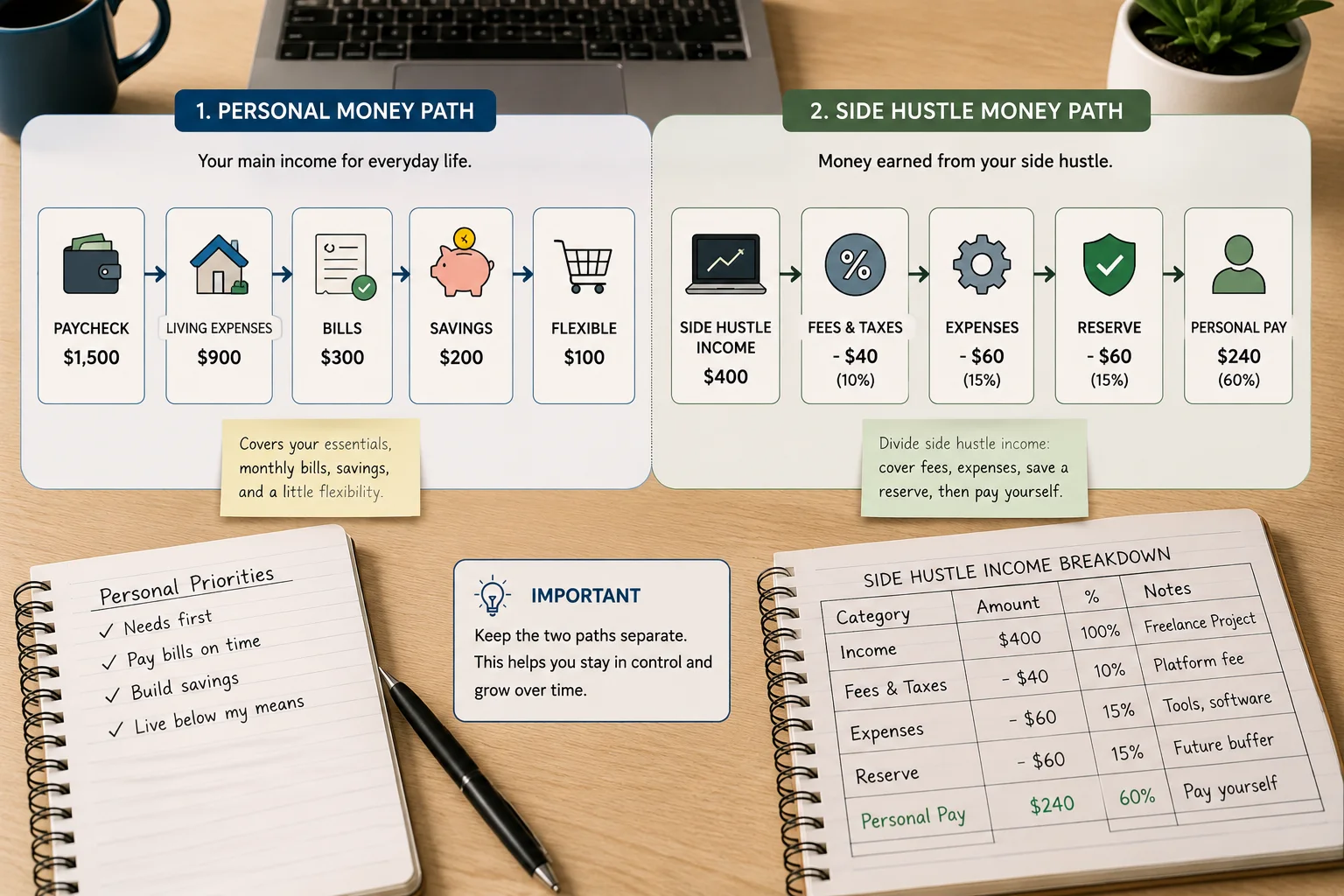
A simple system is to divide every payment into parts. You can adjust the percentages, but here is a beginner-friendly example:
- 50% for personal pay
- 20% for taxes or future obligations
- 20% for business expenses and tools
- 10% for emergency buffer or reinvestment
So if you receive $100 from Fiverr, you might take $50 for yourself, keep $20 aside for tax or future payments, keep $20 for business costs, and save $10 for growth. This is just an example, not a fixed rule.
When I started thinking this way, it made online income feel less random. Even small payments started to have a purpose. Instead of asking, “What can I buy with this?” I started asking, “Where should this money go?” That one question changes alot.
Step 5: Create a Tax Saving Habit Early
Taxes depend on your country, income level, business type, and local rules, so I will not pretend one answer fits everyone. But the general idea is simple, if your side hustle makes money, you should not ignore taxes.
Many beginners make the mistake of spending everything they earn, then later realizing they should have kept records or saved a portion. Even if you are not earning a huge amount yet, it is smart to build the habit early.
You can create a separate “tax” or “future payments” account. Every time you receive money, move a percentage there before touching the rest. Some people save 10%, some save 20%, some save more depending on their country. The exact number should come from a proper accountant or your local tax guidance.
The point is not to panic about taxes. The point is to avoid being surprised.
Step 6: Use Separate Payment Methods When Possible
A separate account is good, but separate payment methods make things even cleaner. If you can, use one card or wallet only for side hustle expenses. This makes tracking easier because all business-related spending stays in one place.
For example, if you buy Canva Pro for freelance design, pay it from your side hustle account. If you buy shipping supplies for eBay, pay from the side hustle account. If you pay for hosting for your blog, use the same business payment method.
This avoids the annoying situation where your personal card has business expenses mixed with food, transport, shopping, and entertainment. Later, when you review your monthly spending, you will not have to guess what was business and what was personal.
Step 7: Keep Platform Fees in Mind
Side hustlers often forget fees because they are taken before or during the payout. But fees matter alot, especially on platforms like Fiverr, Upwork, eBay, PayPal, Payoneer, or payment gateways.
Let us say you charge $50 for a service. You may not actually receive $50. The platform may take a service fee, then the payment processor may take a fee, then currency conversion may reduce the amount again. If you are selling products, the cost can be even more because you have shipping, packaging, refunds, and supplier cost.
This is why separating finances is not only about being tidy. It helps you price better. If you know your actual take-home amount, you can stop undercharging.
Example: If you sell a product on eBay for $40, and your product cost is $20, shipping is $6, platform and payment fees are $5, your real profit is only $9. Without tracking, you may think you made $20 profit, but that is not true.
Step 8: Build a Small Business Emergency Fund
Your personal emergency fund and business emergency fund should not be the same thing. Your personal emergency fund protects your life. Your business emergency fund protects your side hustle.
Even a small side hustle can face unexpected costs. A client may delay payment. An eBay buyer may request a refund. A tool subscription may renew. Your laptop may need repair. Your domain or hosting may expire. If you have no buffer, one small problem can break your flow.
Start with a small goal, like $100 or $250 in a separate business buffer. Then slowly grow it. The amount depends on your side hustle. A freelancer may need less buffer than an eBay seller because product-based businesses usually have more costs.
This buffer gives you confidence. You stop using personal money every time your side hustle needs something.
Step 9: Reinvest Without Overspending
Reinvesting is important, but beginners sometimes use “reinvestment” as an excuse to buy everything. A new laptop, premium software, paid courses, ads, themes, plugins, templates, and tools can drain your money fast.
Before buying anything for your side hustle, ask these questions:
- Will this help me earn more money?
- Will this save me time every week?
- Do I really need it right now?
- Can I use a free or cheaper option first?
- Did I already make enough profit to justify this purchase?
For example, if you are starting on Fiverr, you may not need every paid tool on day one. You can start with free tools, earn first, then upgrade. If you are starting eBay selling, you do not need to buy a huge amount of stock before testing demand. If you are starting a blog, you do not need the most expensive theme or plugin stack at the start.
Good reinvestment makes your side hustle stronger. Bad reinvestment just makes you feel productive while your money disappears…
Step 10: Make a Monthly Money Review
At the end of each month, do a simple review. This does not need to be complicated. Spend 20 to 30 minutes checking your side hustle money.
Here is what to review:
- Total income from all platforms
- Total fees and expenses
- Net profit after expenses
- How much you paid yourself
- How much you saved for taxes or future payments
- Which platform earned the most
- Which expense was unnecessary
- What you should improve next month
This monthly review is where you become better with money. You may notice that Fiverr brings quick projects but Upwork brings better long-term clients. You may notice that eBay sales look good but shipping is hurting profit. You may notice that one subscription is not worth keeping anymore.
Without a review, you are guessing. With a review, you are making decisions based on real numbers.
Common Mistakes Side Hustlers Make
Most side hustle finance mistakes are not dramatic. They are small habits repeated for months. Here are some common ones to avoid.
1. Treating all income as profit
If you make $1,000, that does not mean you earned $1,000 in profit. You need to subtract platform fees, tools, product costs, shipping, refunds, ads, and other expenses.
2. Using personal money for business costs
Sometimes it is unavoidable in the beginning, but do not make it a habit. If your side hustle always needs personal money to survive, you need to check if it is actually profitable.
3. Not saving for slow months
Freelancing and online income can change month to month. One month you may get three clients, next month only one. A buffer helps you stay calm.
4. Forgetting refunds and chargebacks
This is especially important for eBay sellers, digital product sellers, and service providers. Do not spend every dollar instantly because some money may need to go back.
5. Not keeping proof
Invoices, receipts, screenshots, bank records, and platform statements are boring until you need them. Keep them organized from the start.
A Simple System You Can Start This Week
If you are feeling overwhelmed, do not try to build a perfect financial system in one day. Start with this simple setup:
- Create one separate account or wallet for side hustle income.
- Create a simple spreadsheet with income and expenses.
- Move a percentage of every payment into savings for tax or future costs.
- Pay yourself only after fees and expenses are considered.
- Review your money once per month.
That alone puts you ahead of many beginners. You can improve the system later when your income grows.
Example: How This Looks for a Fiverr Freelancer
Let us say you are doing thumbnail design or article writing on Fiverr. You complete orders and receive $300 in one month after Fiverr fees. Instead of moving all that money into your personal account, you keep it in your side hustle account.
Then you divide it like this:
- $150 for personal pay
- $60 for tax or future obligations
- $60 for tools, internet, and business expenses
- $30 for business emergency savings
Now you know exactly what happened to the money. You are not just spending randomly. Even if the amounts are small, the habit is powerful.
Example: How This Looks for an eBay Seller
Now imagine you sell small products on eBay. You make $600 in sales in a month. But your product cost is $300, shipping and packaging cost $90, and fees cost $70. Your real profit is $140.
If you only look at the $600 sales number, you may feel like the business is doing great. But the real number is much smaller. This is why eBay sellers need clean separation and tracking. Product-based side hustles can fool you because money moves in and out quickly.
Before paying yourself, you should first cover product cost, shipping, fees, refunds, and restocking money. Only after that should you take personal profit.
Example: How This Looks for a Blogger or Content Creator
If you run a blog, YouTube channel, or affiliate site, income may come slowly at first. You might spend money on hosting, domain renewal, thumbnails, editing tools, or content tools before you earn much.
This is where tracking helps a lot. You can see whether your content project is moving toward profit or just collecting expenses. You do not need to quit early, but you should know the numbers.
For example, if your blog earns $40 from ads but costs $12 for hosting and $15 for tools, your profit is $13. That is not bad if the site is growing, but you need to know the truth. Clear numbers help you stay patient and realistic.
When Should You Make It More Official?
At the start, you may only need a separate account, spreadsheet, and basic records. But as your side hustle grows, you may need to take it more seriously.
You should consider getting proper guidance when:
- Your side hustle income becomes consistent every month
- You start working with bigger clients
- You sell products regularly
- You hire people or outsource work
- You are unsure about taxes or business registration
- You want to open a proper business bank account
This does not mean you need to rush. It simply means your system should grow with your income. A side hustle can start small, but if you manage it well, it can become a real income source.
Final Thoughts
Separating business and personal finances as a side hustler is not only for big business owners. It is for anyone who wants to take their online income, freelancing, selling, or small business seriously.
When you keep everything mixed, your money feels confusing. You may earn money but still feel broke. You may work hard but not know if the effort is worth it. You may spend business money without noticing. But when you separate things, you get control.
Start simple. Create a separate place for side hustle income. Track every payment. Record expenses. Save for taxes or future costs. Pay yourself properly. Review your numbers every month.
You do not need to be perfect from day one. You just need to be more organized than you were yesterday. That is how a small side hustle slowly becomes something stable…
Disclaimer: This article is for educational purposes only and should not be taken as financial, legal, or tax advice. Rules can be different depending on your country and personal situation, so consider speaking with a qualified professional before making major financial or business decisions.