The “Anti-Budget” Method for People Who Hate Budgeting
Let me be completely honest with you… I used to think budgeting was something only people with accounting degrees could pull off. Every time I sat down with a spreadsheet to track every single dollar, I’d get about two weeks in and just… give up. The guilt, the exhaustion, the feeling like I was failing at something that should be simple. Sound familiar? If you’re nodding your head right now, you’re not alone.
The truth is, traditional budgeting doesnt work for everyone. And I learned that the hard way. After years of trying and failing to stick to a detailed budget, I finally discovered something that actually clicked: the anti-budget method. And let me tell you, it changed everything for me.
What Exactly Is the Anti-Budget Method?
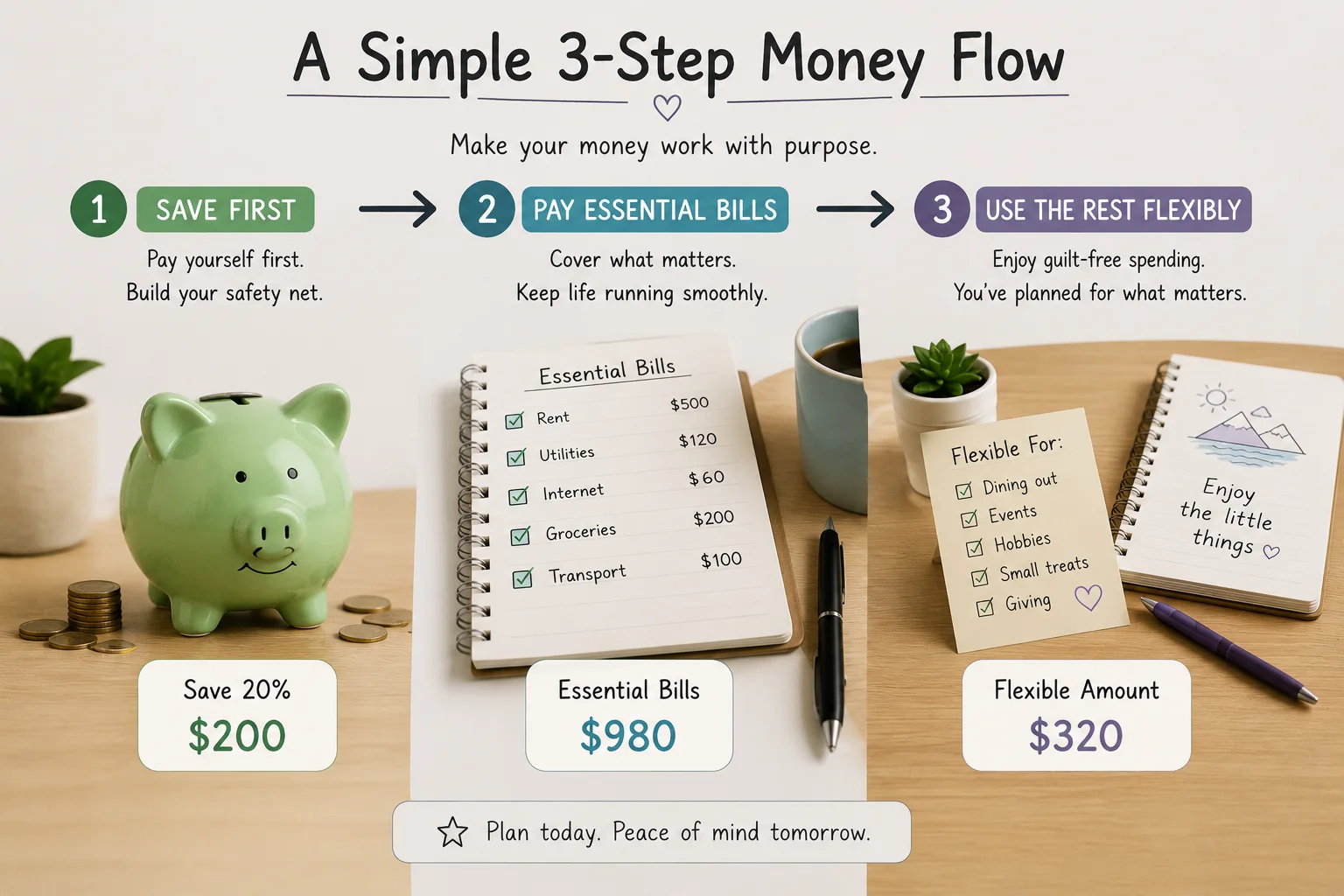
The anti-budget is a money management approach where you automate your savings and investing first, pay your fixed bills, and then spend whatever remains without tracking categories. The discipline lives entirely in the savings step. Once that money is moved into savings, you stop counting.
I know what you’re thinking… “Wait, so I just save first and then spend the rest without tracking? That sounds too simple.” And you’re right, it is simple. But that’s exactly the point. The anti-budget is associated with Paula Pant of Afford Anything, who popularized it as an antidote to the burnout of traditional category budgeting. The argument is simple: most people who fail at budgeting fail because the tracking is exhausting, not because they can’t save. Strip out the tracking, automate the savings, and you remove the part most people quit.
I remember the first time I tried this method. I was working on a freelance project for a client I found through Upwork, and my income that month was all over the place. I had convinced myself that I needed to track everything down to the penny or I’d end up broke. But after three months of obsessive tracking that left me feeling anxious and deprived, I was ready to try anything else. The anti-budget was that anything else.
Why Traditional Budgeting Fails So Many People
Before we go deeper into the anti-budget, let’s talk about why traditional budgeting fails. And I’m speaking from experiance here… I’ve tried every budgeting app you can think of. Mint, YNAB, EveryDollar. I’ve done the cash envelope system. I’ve tracked expenses in Google Sheets until my eyes crossed. And you know what happened every single time? I’d stick with it for a few weeks, maybe a month if I was really motivated, and then I’d fall off the wagon.
The problem with line-item tracking is that it consumes a massive amount of your time, energy and effort. The entire process feels like a tough uphill battle, and you hold a high likelihood of giving up. Just as most people abandon their diets, most people also abandon their budgets.
And if you’re a freelancer or someone with irregular income? Traditional budgeting becomes even harder. I’ve had months where I earned $4,000 from a combination of Fiverr gigs, eBay dropshipping sales, and a few freelance writing projects. And I’ve had months where I earned barely $1,200. Trying to plan a detailed budget around that kind of volatility is like trying to hit a moving target in the dark.
How the Anti-Budget Method Actually Works
Alright, so how do you actually do this anti-budget thing? The premise is simple: pull your savings off the top first, then go wild with the rest. When I say “go wild,” I mean you can spend this money freely, without needing to track where it’s going. It doesn’t matter whether your groceries come to $173.58 or $192.49. You no longer need such detailed information.
Here’s the step-by-step breakdown of how I do it, and how you can too…
Step 1: Decide Your Savings Rate
Pick a percentage of your take-home pay that gets saved and invested before anything else. Most anti-budget proponents suggest 20% to 30%. I personally started with 20% and worked my way up to 25% over time. The key is to pick a number that feels achievable but still meaningful.
If you’re just starting out and 20% feels like too much, start with 10%. You can always increase it later. The important thing is to start.
Step 2: Automate Transfers on Payday
The moment your paycheck hits, transfers fire off automatically: a portion to savings, a portion to your retirement or brokerage account. This is crucial. If you have to manually transfer the money, you’ll find excuses not to do it. Automation removes the willpower factor.
I set up automatic transfers from my checking account to a separate savings account at a different bank. Why a different bank? Because if I dont see my savings balance when I log into my primary accounts, I’m less tempted to dip into it.
Step 3: Pay Your Fixed Bills
Rent or mortgage, utilities, insurance — the predictable monthly stuff. These come next. I have most of my fixed bills on auto-pay too, so I dont even have to think about them.
Step 4: Spend the Remainder Freely
Groceries, dining, entertainment, shopping. No category caps. No tracking. When the account hits zero, you stop until next payday.
This is the part that scared me the most when I first started. “What if I spend too much on eating out?” “What if I overspend on something stupid?” But here’s what I learned… because I had already saved first and paid my bills, whatever was left was genuinely mine to spend. I could enjoy it without guilt.
The Anti-Budget vs Other Popular Methods
The anti-budget isnt the only simplified budgeting method out there. Two other popular approaches are the 50/30/20 rule and the pay yourself first method. Let me break down how they compare…
The 50/30/20 Rule
The 50/30/20 rule is one budgeting method where you allocate 50% of your income to needs, 30% to wants, and 20% to savings. Needs are essentials like rent, groceries, utilities, and insurance. Wants are non-essentials like dining out, entertainment, and travel. And savings covers everything from emergency funds to debt repayment.
This method is simple and balanced, and it works well if your expenses are predictable. But if you have irregular income, it can be tricky. When your income fluctuates, the 50/30/20 percentages can feel impossible to maintain. One month you might have plenty for wants, the next month you’re struggling to cover needs.
I tried the 50/30/20 rule for a few months when I was first starting out as a freelancer. It worked okay during high-income months, but during slow months, I found myself stressed about whether I could even hit the 50% needs category. It just didnt flex well with my income patterns.
The Pay Yourself First Method
The pay-yourself-first budget is a reverse budgeting strategy where you save a chunk of your income first — essentially treating your savings like a bill — then use the rest of your money to cover expenses and spend however you see fit. It’s also called reverse budgeting.
This method is easier than other types of budgets because you don’t have to spend time tracking your expenses. As long as you’re prioritizing savings, covering your bills, and not taking on more debt, you’re good to go.
The pay yourself first method is actually very similar to the anti-budget. In fact, the 50/30/20 method and the 80/20 method are two types of pay-yourself-first budgets. The main difference is that the anti-budget is even more stripped down — there’s no category tracking at all, not even the broad categories of the 50/30/20 rule.
Making the Anti-Budget Work with Irregular Income
Here’s where things get really interesting… Because if you’re a freelancer, gig worker, or anyone with irregular income, the anti-budget can be a game changer. But you need to adapt it slightly.
One of the biggest challenges with irregular income is that you don’t know how much you’ll earn each month. So how do you decide on a savings rate when you dont know what your income will be? Here’s what I’ve learned through trial and error…
Use a Percentage, Not a Fixed Amount
Instead of saving a fixed dollar amount each month, save a percentage of whatever comes in. If you earn $2,000 one month and save 20%, that’s $400. If you earn $5,000 the next month and save 20%, that’s $1,000. The percentage stays consistent, but the dollar amount flexes with your income.
I’ve been doing this for about two years now, and it’s made a huge difference. Some months I save more, some months I save less, but I always save something. And over time, those savings add up.
Build a Buffer
For irregular earners, a 3- to 6-month emergency fund is ideal, but start with one month of bare-bones expenses in an income holding account. This buffer smooths out the lean months. When you have a high-earning month, the surplus goes into the buffer. Then in low months, you pay yourself from that buffer.
I learned this lesson the hard way. There was a month where two of my biggest clients delayed payment, and I ended up with almost no income for six weeks. If I hadn’t built up a buffer, I would have been in serious trouble. Now, I always keep at least three months of expenses in my buffer account.
Base Your Budget on Your Lowest Expected Income
Budget conservatively: base your budget on your lowest expected income to avoid stress during slow months. Look at your last 6 to 12 months of income and find your lowest month. That’s your baseline. Keep your essential expenses below that baseline.
When I first started freelancing, I made the mistake of budgeting based on my average income. Then a slow month would hit and I’d be scrambling to cover basic expenses. Now I budget based on my lowest month, and anything above that is bonus.
Common Mistakes to Avoid with the Anti-Budget
Even though the anti-budget is simple, there are some common pitfalls. I’ve made most of them myself, so let me save you the trouble…
Mistake 1: Skipping the Savings Step
The anti-budget only works if you actually do the saving up front. If you tell yourself “I’ll save whatever is left at the end of the month,” you’re not doing the anti-budget. You’re just spending and hoping. The whole system depends on front-loading the discipline.
I made this mistake early on. I thought I could just spend less and save whatever was left. Spoiler alert: there was never anything left. The money always found a way to get spent. That’s why automation is so important.
Mistake 2: Setting Your Savings Rate Too High
If you set your savings rate at 40% and you can’t actually live on the remaining 60%, you’re going to fail. The anti-budget should feel liberating, not stressful. Start with a lower percentage and work your way up.
Mistake 3: Not Adjusting for Irregular Income
If you have irregular income, you need to adapt the method. Using a percentage instead of a fixed amount, building a buffer, and basing your budget on your lowest expected income are all crucial adjustments. Don’t try to force a steady-income method onto a variable-income situation.
Mistake 4: Feeling Guilty About Spending
The whole point of the anti-budget is to spend the remainder guilt-free. If you’ve saved first and paid your bills, whatever is left is yours to enjoy. Don’t beat yourself up for buying a coffee or going out to dinner. You’ve already done the responsible thing.
Real Examples of the Anti-Budget in Action
Let me share some real scenarios so you can see how this works in practice…
Example 1: The Freelance Writer
Sarah is a freelance writer who earns between $2,500 and $4,500 per month. She uses the anti-budget with a 25% savings rate. On a $3,200 month, she automatically transfers $800 to savings, pays her fixed bills ($1,200 for rent, utilities, insurance), and has $1,200 left for everything else. She doesn’t track categories. Some months she spends more on groceries, some months more on dining out. But because she saved first, she doesn’t stress about it.
Example 2: The eBay Dropshipper
Mike runs an eBay dropshipping business. His income is even more irregular than Sarah’s — some months he makes $5,000, other months barely $1,500. He uses a 20% savings rate and has built a buffer of three months of expenses. In high months, the extra goes into his buffer. In low months, he pays himself from the buffer. This smooths out the rollercoaster and keeps his finances stable.
Example 3: The Fiverr Gig Worker
Jessica does various gigs on Fiverr — logo design, social media management, and voiceover work. Her monthly income ranges from $800 to $2,500. She uses a 15% savings rate (she started lower because her income was lower) and keeps her essential expenses under $700. In good months, she builds her buffer. In slow months, she relies on the buffer. She’s been doing this for 18 months and now has a comfortable emergency fund.
Tips for Getting Started with the Anti-Budget
Ready to give it a try? Here’s how to get started…
- Start small. If 20% feels too high, start with 10%. You can always increase it later.
- Set up automation. This is non-negotiable. Set up automatic transfers on payday so you don’t have to think about it.
- Use separate accounts. Keep your savings in a different bank from your spending account. Out of sight, out of mind.
- Track your fixed bills. You still need to know what your fixed bills are so you can pay them. But you don’t need to track variable spending.
- Give it at least three months. The first month might feel weird. Give yourself time to adjust to the new system.
- Adjust as needed. If your savings rate is too high or too low, change it. The anti-budget is flexible.
Is the Anti-Budget Right for You?
The anti-budget isn’t for everyone. If you love tracking every penny and get satisfaction from detailed spreadsheets, you might prefer a traditional budget. But if any of these sound like you, the anti-budget could be a great fit…
- You’ve tried traditional budgeting and given up multiple times.
- The thought of tracking every expense makes you feel exhausted.
- You have irregular income and traditional budgets feel impossible.
- You want to save money but don’t want to feel deprived.
- You prefer simple systems that require minimal maintenance.
For me, the anti-budget was the first budgeting method that actually stuck. I’ve been using it for over two years now, and I’ve saved more money than I ever did with traditional budgeting. The freedom of not tracking every penny actually made me more mindful of my spending, not less. And the automation means I don’t have to think about it — the savings happens whether I remember to do it or not.
Frequently Asked Questions
What if I spend all my remaining money before the end of the month?
Then you stop spending until next payday. That’s the system. Over time, you’ll naturally learn to pace yourself. Most people find that they actually spend less with the anti-budget because they’re not constantly in a state of deprivation.
How do I know if my savings rate is right?
If you’re consistently running out of money before the end of the month, your savings rate might be too high. If you have lots of money left over at the end of the month, you could probably increase your savings rate. It’s a balance.
Can I use the anti-budget if I have debt?
Absolutely. Your savings rate can include extra debt payments. The anti-budget is about saving first — and paying down debt counts as saving in this context.
What about irregular expenses like car repairs or annual insurance?
These are fixed bills. You should include them in your fixed bills category. If you know you’ll need $600 for car insurance in six months, set aside $100 per month. That’s still a fixed bill.
Is the anti-budget the same as the pay yourself first method?
They’re very similar. The pay yourself first method is a broader category that includes the anti-budget and the 50/30/20 rule. The anti-budget is the most stripped-down version — no category tracking at all.
Final Thoughts
Look, I’m not a financial expert. I’m just someone who struggled with traditional budgeting for years and finally found something that works. The anti-budget might not be perfect for everyone, but if you’re someone who hates tracking every penny, it’s worth a shot.
Start with a savings rate that feels comfortable. Set up automation so you don’t have to think about it. Pay your fixed bills. And then enjoy the rest without guilt. It really is that simple.
I’ve been using this method for over two years now, and I’ve saved more money than I ever did with detailed tracking. The freedom is incredible. No more spreadsheet anxiety. No more guilt about every purchase. Just a simple system that works.
Give it a try for three months. What do you have to lose? If it doesn’t work, you can always go back to tracking every penny. But I have a feeling you might just find that the anti-budget is exactly what you’ve been looking for…
Disclaimer: This content is for educational purposes only and does not constitute financial advice. Always consult a qualified financial professional regarding your specific situation.