Personal Finance Budgeting Tips Low Income Money Plan

How to Stop Living Paycheck to Paycheck, A Realistic Plan That Actually Works

I used to think living paycheck to paycheck was only a low income problem. But the more I looked into it, and the more I watched how people actually handle money, the more I realized thats not fully true. Some people earn very little and still manage to stay in control. Others make a decent income and somehow end up broke a few days before payday… again and again.

So if you are tired of constantly checking your balance, delaying bills, borrowing a little here and there, and promising yourself that next month will be different, this article is for you. I am not going to give you fake motivation or some fantasy budget that only works if you already have a perfect income. I want to talk about a realistic plan to stop living paycheck to paycheck, one that actually fits real life.

The goal is not to become rich overnight. The goal is to create breathing room. Even a small gap between what you earn and what you spend can change your stress level so much. Once that gap appears, you finally start moving forward instead of just surviving.

The simple truth: To stop living paycheck to paycheck, you need to do three things at the same time, control the leaks, build a tiny buffer, and increase income in a realistic way. Miss one of those, and progress gets slower.

Why So Many People Stay Trapped in the Cycle

Most people are not bad with money because they are lazy or careless. They are stuck because life is expensive, income is unstable, and small mistakes keep stacking up. A food delivery here, a late fee there, a random subscription, transport costs, mobile data, tiny impulse buys… it all adds up quietly.

Then there is the mental side of it. When money is tight, you dont think long term. You think about getting through this week. Thats why a lot of people spend their full paycheck fast. The money feels like relief when it arrives, so they loosen up for a day or two, then the pressure returns. I get it… it feels exhausting.

Another big reason is irregular income. If you are freelancing, doing online work, side hustles, small business, or even part-time work, your money is not always predictable. One week you are okay, next week things feel shaky. That makes normal budgeting harder, but not impossible.

Important: If your income is truly too low to cover your basics, budgeting alone will not solve everything. You will still need a plan to grow income. That is not failure, thats just reality.

Step 1, Find Your Real Survival Number

Before doing anything else, I think the first move is to figure out your minimum monthly survival number. This is the amount you need to cover your essential life, not your ideal life. That means rent, groceries, transport, electricity, internet, debt minimums, medicine, and other real needs.

Do not guess this number. Write it down properly. When you guess, you lie to yourself without meaning to. I have seen people say they spend very little, then once they track it, they realize dozens of small costs were missing.

What to include in your survival budget

  • Rent or housing contribution
  • Electricity, water, internet, phone
  • Groceries and basic food
  • Transport or fuel
  • Minimum debt payments
  • Medicine and important family costs
  • One small buffer for unexpected essentials

Once you know this number, everything gets clearer. You stop saying, “I need more money,” and start saying, “I need $180 more every month to stop drowning.” That is way more useful.

Small win: When you know your exact number, your goal stops feeling huge and scary. It becomes measurable. That matters a lot.

Step 2, Track the Leaks Before You Cut the Big Things

A lot of personal finance advice tells people to immediately cut all fun spending. That sounds smart, but in real life it usually fails. When the plan feels too painful, people quit. What worked better for me was looking for the money leaks first.

Money leaks are the expenses that dont improve your life much, but still keep draining your balance. These are sneaky because each one feels small by itself.

Common money leaks

  • Subscriptions you barely use
  • Food delivery when there is food at home
  • Daily snacks and drinks bought out of habit
  • Bank fees, transfer charges, or late fees
  • Impulse purchases during stress or boredom
  • Buying cheap things repeatedly instead of one good one

Try this for 14 days. Write down every single expense. Yes, even the tiny ones. After that, highlight the ones that were not truly necessary. You will probably notice patterns. Most people do. Sometimes the problem is not one giant expense, its ten small careless ones.

Expense Type Looks Small Monthly Impact
Coffee or drinks $2 to $3 a day $60 to $90
Food delivery extras $4 service fees $40+
Unused subscription $8 to $15 $96 to $180 a year
Late payment fee $10 to $25 Pure money loss

Step 3, Build a Bare Minimum Budget You Can Actually Follow

I do not believe in creating a budget that looks perfect on paper but falls apart by the tenth day of the month. A realistic budget needs to match your actual habits, your location, your responsibilities, and your current income level.

That is why I prefer a bare minimum budget first. Keep it simple. Essentials come first, then a tiny savings target, then everything else. If you are currently living paycheck to paycheck, this is not the time to build some fancy spreadsheet with twenty categories that you will never update.

A simple starting structure

  • Essentials: 70% to 80%
  • Debt minimums: whatever is required
  • Mini savings: even 3% to 5% is a start
  • Flexible spending: the rest

The part many people skip is that savings should still exist, even if the amount is small. I know saving $10 or $20 can feel pointless, but it is not. That tiny amount is what slowly creates your first buffer, and that buffer is what stops every small emergency from becoming a crisis.

Do not do this: Dont wait until you “earn more” to start saving. Most people who say that still dont save after the raise comes. Start with a tiny amount now, then grow it later.

Step 4, Stop Spending Your Paycheck in One Wave

This one is huge. Many people receive money and mentally treat the full amount as available. Then within a few days, a big chunk is gone. Bills are still coming, but the balance already dropped.

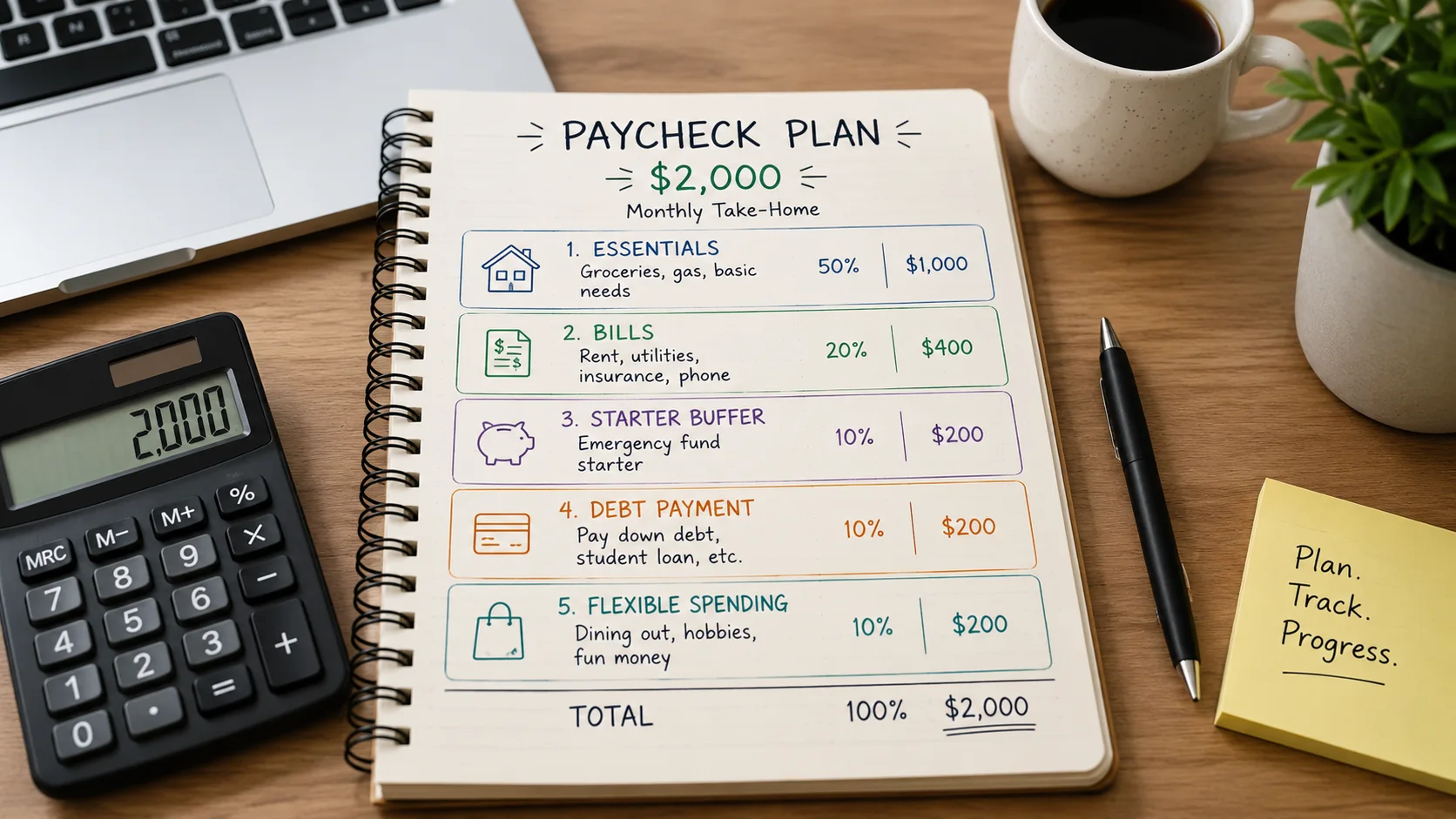
A better way is to split the paycheck immediately. The moment money comes in, divide it into purpose buckets. You can do this with separate accounts, envelopes, notes on your phone, or just a simple spreadsheet.

Example of a paycheck split

  • Bills and essentials
  • Transport and food
  • Debt payments
  • Emergency fund
  • Small personal spending amount

This method works because it removes the illusion that all the money is free to use. It creates friction, and honestly that friction helps. A lot.

Step 5, Save Your First Emergency Fund, Even If It Feels Tiny

When I say emergency fund, I am not talking about saving six months of expenses right away. Thats too big for most people at the start. The first goal is much smaller. Aim for your first $100, $250, or $500, depending on your reality.

Why does this matter? Because living paycheck to paycheck becomes brutal when every small problem has to go on debt or comes out of your next meal budget. A phone repair, medicine, transport issue, or sudden bill can throw the whole month off.

Your first emergency fund is not about investing. It is about protection. Keep it easy to access, but not too easy to spend. A separate savings account is usually fine.

My view: The first emergency fund gives you something money rarely gives stressed people, time to think. When a problem happens, you react calmly instead of panicking.

Step 6, Increase Income in a Way That Fits Your Life

Sometimes the truth is simple. You cannot budget your way out of a serious income gap forever. At some point, income has to rise. That does not always mean getting a second full job. It can mean using a skill, creating a small online income stream, or doing work that fits around your current schedule.

This is where many people overcomplicate things. They search for the perfect side hustle instead of starting one realistic thing.

Some realistic income ideas people use

  • Freelancing on Fiverr or Upwork, writing, design, video editing, virtual assistance, data entry, voice work, or social media help
  • Selling a service locally, tutoring, fixing phones, helping with resumes, managing pages for small shops
  • Reselling online, flipping small items, used electronics, or products with actual demand
  • eBay selling, not random guessing, but learning fees, demand, shipping costs, and choosing products carefully
  • Simple digital products, templates, guides, printables, or niche resources

I want to say this clearly though, side income is not magic. It takes time. But even an extra small amount each week can break the paycheck-to-paycheck pressure if you handle it wisely. The biggest mistake is treating extra income like bonus spending money. If you are trying to escape the cycle, most of that extra money should go toward your buffer, bills, or debt first.

For example, if someone starts freelancing and earns an extra $100 to $200 a month from Fiverr or Upwork, that may not sound life changing. But if that full amount goes into emergency savings or bill relief, it changes the next month a lot. That is how stability starts…

Step 7, Use Debt Carefully, Or It Will Keep Resetting Your Progress

Debt is one of the biggest reasons people feel stuck. Minimum payments eat your paycheck, interest makes everything slower, and using debt to cover normal living costs becomes a trap.

If you have debt, be honest about it. List every one of them. Balance, minimum payment, and interest rate. Then choose a strategy.

Two simple debt approaches

  1. Snowball method, pay smallest debts first for motivation
  2. Avalanche method, pay highest interest debts first to save more money

Both can work. The important part is that you stop adding new debt while trying to clear old debt. That part sounds obvious, but it is where a lot of people get stuck.

Hard truth: If every emergency goes onto debt, and you have no buffer at all, progress will keep getting erased. That is why even a tiny emergency fund matters before aggressive debt payoff.

Step 8, Create a One Paycheck Buffer, Then Grow It

This is one of my favorite money goals because it feels real. Instead of jumping straight to “save six months of expenses,” try building a one paycheck buffer first. That means your current bills are no longer depending fully on the paycheck that just arrived. You have one layer of breathing room.

Once you reach that, life feels less chaotic. Bills stop feeling like emergencies. You stop timing every expense so tightly. Then you can work toward a bigger emergency fund from there.

The order I would follow

  1. Track spending
  2. Cut leaks
  3. Build first small emergency fund
  4. Increase income where possible
  5. Create one paycheck buffer
  6. Then build 1 to 3 months of expenses

Step 9, Make Your Plan Boring, Because Boring Works

The truth about personal finance is that the boring stuff works better than the exciting stuff. Automatic transfers, simple rules, a spending limit, one side income goal, one savings goal, one debt target… that wins more often than complex systems.

You do not need to become obsessed with money. You just need a few habits that repeat. That is it. In fact, if the plan feels dramatic, it probably wont last.

A realistic money rule: When income comes in, decide the job of each part before spending any of it. That one habit alone can prevent so much damage.

A 30 Day Realistic Reset Plan

If I had to start over and stop living paycheck to paycheck as realistically as possible, this is the plan I would follow in the next 30 days:

  • Day 1 to 3: Write down all monthly essentials and find the real survival number
  • Day 4 to 10: Track every expense, no excuses
  • Day 11 to 15: Cancel or reduce at least 2 to 3 money leaks
  • Day 16: Open or assign a separate savings place for emergencies
  • Day 17 to 20: Save the first small amount, even if it is tiny
  • Day 21 to 25: Start one realistic extra income path, freelance gig, local service, or online selling
  • Day 26 to 30: Create your paycheck split system for the next month

This may sound basic, but basic is good when your finances feel messy. Fancy plans usually break. Simple plans survive.

Common Mistakes That Keep People Stuck

  • Guessing expenses instead of tracking them
  • Trying to save nothing until income rises
  • Using side hustle money for lifestyle upgrades too early
  • Ignoring late fees and small repeated charges
  • Budgeting perfectly for one week, then giving up after one mistake

That last one matters a lot. One bad spending day does not mean the whole month is ruined. A lot of people fall off because they think one mistake means failure. It doesnt. Just reset and continue.


Frequently Asked Questions

Can you stop living paycheck to paycheck on a low income?

Yes, but it is harder, and it usually requires both better money management and some income growth. If your income is extremely tight, budgeting alone may not be enough. You may need a side income, better job, or extra freelance work to create room.

How much should I save first?

Start with the first small emergency fund goal, maybe $100, $250, or $500. The amount matters less than the habit at the beginning. Once you build that, move toward a one paycheck buffer.

What is the fastest way to stop living paycheck to paycheck?

The fastest realistic way is to combine three actions, cut obvious spending leaks, stop spending the full paycheck in one wave, and bring in extra income that goes toward savings or debt instead of random spending.

Final Thoughts

If you are living paycheck to paycheck right now, I want to say this clearly, it does not mean you are bad with money forever. It means you need a better system, more breathing room, and maybe a stronger income plan. Thats all. This can change.

You do not need to fix your whole financial life in one month. Just start by making the cycle a little less tight. Cut a few leaks. Save a tiny emergency fund. Split your paycheck with purpose. Start one realistic income stream. Then keep going.

That is how people actually escape this, not with fake overnight success, but with repeated small moves that slowly turn into stability. It may feel slow at first, but slow progress is still progress… and honestly, stable progress is the kind that lasts.

Your next move: Today, write down your real monthly survival number and track every expense for the next 14 days. That one step alone can show you exactly where the pressure is coming from.

Disclaimer: This article is for educational purposes only and should not be taken as professional financial, legal, or tax advice. Always consider your own situation carefully before making money decisions.

Scroll to Top