Why You Still Feel Broke After Earning Money Online
Online income can create a strange situation. You may see payments arriving from clients, websites, marketplaces, or affiliate programs, but your bank balance still feels empty. It is easy to think the problem is simply that you are not earning enough. Sometimes that is true. But often the bigger problem is that the money has no system.
I have seen how quickly small fees, renewals, payment delays, and random spending can eat online income. This article breaks down the most common reasons and gives a practical way to fix them without pretending that one budget solves every situation.
1. You Are Counting Revenue as Profit
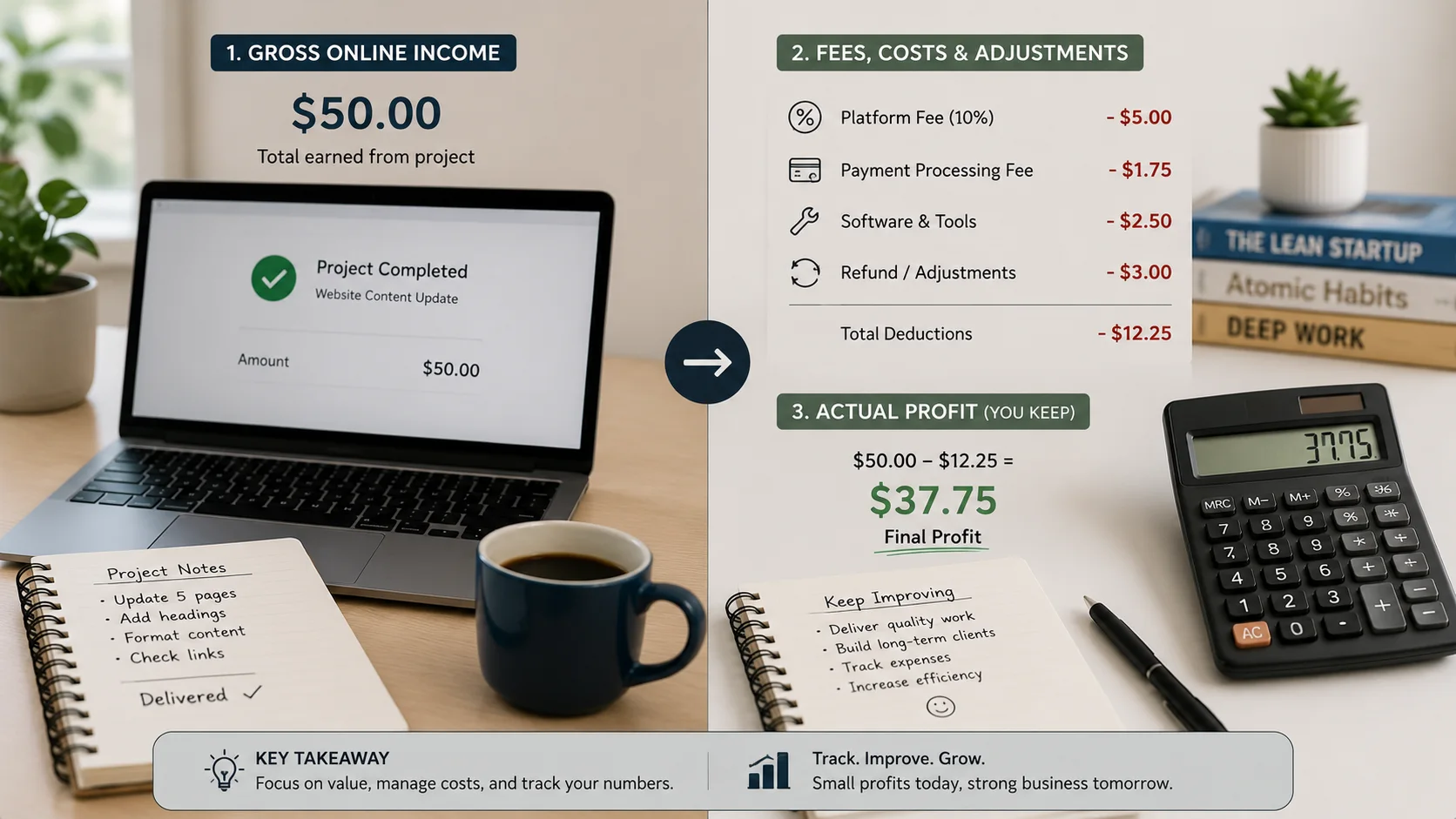
Revenue is the amount paid before costs. Profit is what remains after the costs required to earn it. If a marketplace shows $500 in sales, that does not mean you gained $500.
Sales: $500
Platform and payment fees: $80
Software and hosting: $55
Refunds: $25
Real amount before tax and personal withdrawals: $340
The dashboard number feels good, but the smaller number is the one that can actually support you. Track both so you do not make spending decisions using money that never reached you.
2. Your Income Arrives Randomly but Your Bills Do Not
A freelancer might receive three payments in one week and nothing the next week. A website may earn more during one month and less during another. When income is irregular, a good week can feel like permission to spend.
A better method is to keep online earnings separate and pay yourself on a fixed day. Base that amount on your lower or average months, not the best month you have ever had.
3. Small Business Expenses Feel Too Small to Track
A domain renewal, design tool, small advertisement, plugin, withdrawal fee, and currency conversion may each look harmless. Together they can remove a large part of your profit.
Check recurring subscriptions every month. Cancel tools you are not using. When a service renews yearly, divide the cost by 12 in your records so it does not surprise you later.
4. You Spend Good-Month Money as if It Will Repeat
A strong month is not automatically your new normal. A client can leave, traffic can change, a platform can delay payments, or a product can stop selling. If personal spending rises immediately, the next normal month will feel like a crisis.
Keep part of above-average income as a slow-month buffer. This is not exciting, but it gives you space to reject bad clients and avoid borrowing for basic expenses.
5. You Do Not Pay Yourself a Clear Amount
When business money and personal money are mixed, every purchase feels both affordable and dangerous. You may buy something personally, then realise the same money was needed for hosting or a refund.
Choose a weekly or monthly personal withdrawal. Record it as owner pay. Even if the amount is small, the separation helps you see whether the online activity is supporting you or only moving money around.
6. Pending Payments Make You Feel Rich Too Early
An unpaid invoice, marketplace balance under review, affiliate commission waiting for approval, or payout below the minimum threshold is not usable cash. Some payments can be reversed or delayed.
Keep a separate “pending” column and do not include it in your spending plan until it clears. This one habit can prevent many cash shortages.
7. Refunds and Chargebacks Are Not in Your Plan
Online selling and client work can include refunds, disputes, or chargebacks. Even if they are rare, spending every payment immediately leaves no room when one happens.
Keep a small reserve based on your actual refund history and business risk. Do not copy a random percentage from another business. Review your own numbers.
8. You Are Underpricing the Work
A job can bring money and still be a poor job. If a $20 project takes eight hours, requires several revisions, and includes platform fees, the hourly return may be too low.
Track the full time spent, including messages, research, revisions, delivery, and payment follow-up. When your process improves and demand grows, adjust the price or reduce the scope.
9. You Are Running Too Many Side Hustles
Multiple income sources sound safe, but too many unfinished projects create hidden costs. You pay for several tools, split your attention, and never become good enough at one offer to charge more.
Keep one main income method and, if needed, one small backup. Pause anything that has produced no useful result after a fair test.
10. You Have Income but No Emergency Buffer
Without a buffer, every repair, medical cost, family expense, or slow month takes money from the business. Then the business cannot renew tools or continue marketing, which reduces future income.
Start with a small target you can actually reach. The first goal could cover one important bill or one month of online business expenses. A small buffer is still better than an unrealistic target you never begin.
A Simple Fix I Would Use
- Record every payment that actually cleared this month.
- Subtract fees, refunds, tools, hosting, and other real costs.
- Move pending income into a separate column.
- Choose a fixed amount to pay yourself.
- Keep part of the remaining profit as a buffer.
- Review which income source produced the best result for the time spent.
A Monthly Reality Check
| Question | Why It Matters |
|---|---|
| How much actually reached me? | Removes unpaid and reversed amounts. |
| What did it cost to earn? | Shows real profit instead of sales. |
| How many hours did I spend? | Reveals underpriced work. |
| Which income can repeat? | Separates a lucky payment from a reliable method. |
| What can I stop paying for? | Cuts subscriptions and weak experiments. |
Feeling Broke Is Sometimes a Real Income Problem
A system cannot magically fix income that is genuinely too low for essential expenses. If the numbers still do not work after removing waste, the next step is increasing the value of your main skill, finding better clients, applying for more stable work, or reducing a major cost where possible.
Do not blame yourself for failing to budget money that simply is not enough. Use the numbers to identify the gap, then work on the biggest realistic change.
Disclaimer: This article provides general educational information and is not personal financial, tax, or legal advice.